The third book of the WW2 France Collection, V for Victory, tells the story of Charles Mercier, a young Parisian boy, who finds his own, unique way to fight back against the occupation. It is a coming of age story with a difference and is suitable for both adults and young adults.
Although the collection has recurring characters, all three books in the series can be read as standalones.
The book is available for Kindle at only £2.99 and is also available in paperback. To purchase, click here
To purchase all three books in the collection for just £5.99 for Kindle, click here
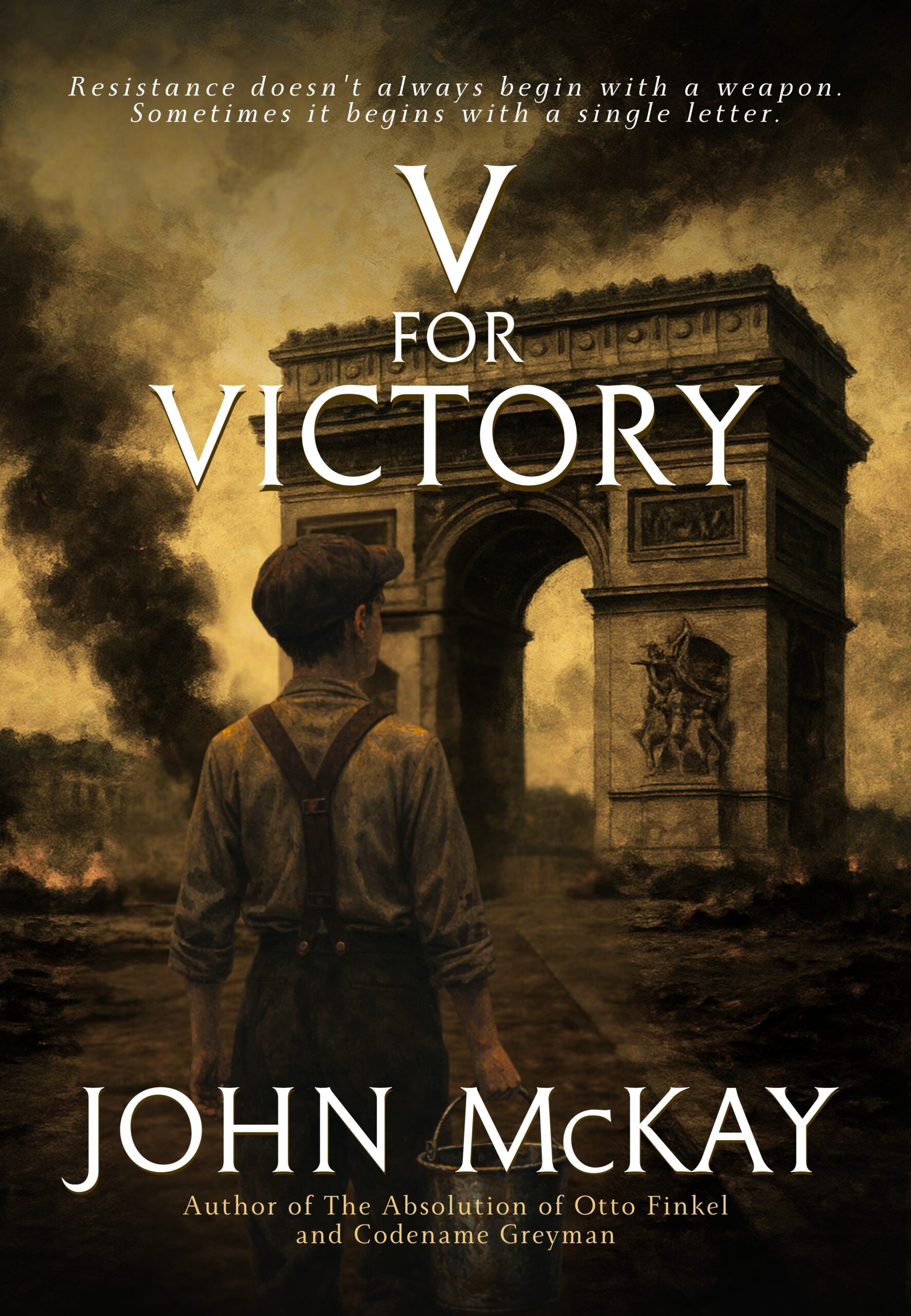

V for Victory
Chapter 1 – The Parade
June 14, 1940 – Paris, France
‘Who are all these people, Charles? I don’t like them.’
Thirteen-year-old Charles Mercier gripped tightly to his young brother’s hand as they watched the Panzers, staff cars and half-tracks roll down the Champs Élysées, followed by the victorious German army, goose-stepping confidently behind them. The sun shone brightly and the birds sang almost cheerily in the trees as the green and grey uniformed soldiers marched purposefully along, following the motorised vehicles. Minutes earlier, cavalry troops had passed them, their impressive mounts snorting heavily in the early summer heat. Charles was glad he had made the effort to walk the mile and a half to see it, for the procession truly was a magnificent display of military might.
He looked down at his sibling and smiled.
‘Don’t worry, Pierre,’ he replied softly, pulling the young boy’s cap down so it covered his eyes. ‘We won’t be here much longer. And see, if you don’t want to look at them, you can just pull your cap down.’
Had it not been for the magnitude of the French defeat and his concern at his mother’s nervous anticipation of what was to come, Charles may have enjoyed the parade a lot more. No matter what he thought of them, he could not fault the Germans’ sense of occasion. This was probably the best thing he had ever seen in his entire life. It was no wonder, he thought, that the German army had experienced little problem in defeating the French and British armies so swiftly, and so easily. They looked strong, powerful and totally invincible.
It was clear to Charles that his six-year-old brother would have preferred to be anywhere else rather than here; he was beginning to regret dragging him along. But there was something within him that compelled him to bear witness to what was taking place here today. Charles had already decided he wanted to be a soldier when he grew up, to follow in the footsteps of his missing father and here was the perfect opportunity to take a look at some close up. He had not been disappointed in what he had seen. This was the most powerful army in the history of the world and he felt privileged to see it.
Charles had fully expected to see the German leader marching at the head of the parade, but he was nowhere to be seen. Then he overheard someone mention that he’d been in the city a few hours earlier, which left Charles feeling a little disappointed. Hitler’s picture was in all the newspapers and Charles wanted to see him for real, to make sure that he actually existed and was not just a two-dimensional image in a photograph or on a newsreel.
His mother had demanded he stay indoors, away from it all. It was none of their business, she said. She told him the Germans did not deserve his curiosity and he had to keep away from them. After all, as far as they knew, their father was still fighting somewhere near to the coast and they were not sure whether he was still alive, or if he had been killed during the blitzkrieg the Germans had conducted so successfully. The strain in his mother’s eyes was evident as she tried to cope with this whilst at the same time attempt to keep her two sons positive and life as normal as she could possibly make it.
Ignoring every word she said, Charles had left their ground floor apartment by the back door. After all, he thought, this was a once in a lifetime opportunity and he did not want to regret missing out on it. It was shortly after he left the building that he realised his brother had followed him. Understanding that to take him home would lead to a severe reprimand from his mother and her then stopping him from going, he’d reluctantly taken him along. If he was going to get a telling off then he might as well see the parade first.
He watched a while longer as the motorcycle combinations roared by, followed by the regiments on foot, immaculately turned out with their rifles and machine-pistols held at the high port as the sun reflected back off their steel-grey helmets. Charles smiled. He really was enjoying himself. This was fantastic.
Charles glanced along the tree-lined avenue, up towards the famous Arc de Triomphe, the monument Napoleon had commissioned to celebrate his many military successes over a hundred years ago. The strangeness of it all was not lost on Charles, despite his young age. A monument built to honour French victories was an ironic backdrop to the country’s worst defeat in its history. Charles thought that maybe the Germans chose this route simply to mock them, to show them who the real rulers of Europe were; to laugh in the faces of the French. He noticed that between the trees the crowds were sparse, most Parisians choosing to stay away, not wishing to give the Nazis the satisfaction of rubbing their victory in their faces.
But then over half the population had left the city, choosing instead to take their chances on the road. Over the last month they had headed south, away from the advancing Germans. In fact, only a week ago his own mother had cajoled the two of them, along with their elderly grandmother who shared their apartment, to embark upon a trek that had been a complete and utter disaster. With no transport and carrying as many of their possessions as they possibly could, they’d joined the thousands of Parisians who were trying to make their escape. After spending only two days on the road, where they were forced to sleep outdoors and abandon most of their belongings, leaving them in ditches at the side of the road, his mother finally saw sense and they had headed back home. Their grandmother developed huge blisters on her feet and had to lean on Charles for miles. With the constant threat of enemy bombardment and aerial attack, his mother decided it was probably safer to return home and take their chances with the occupying army. On arriving back at their apartment many hours later, totally exhausted, they all collapsed into a heap on the sofa in the living room, glad that the looters had chosen to rob other homes and not theirs.
As the last of the parade marched by, a soldier in the rear rank caught Charles’s eye. He seemed to be staring at him. Charles felt a chill run down his spine, despite the heat of the day. There was something about this particular soldier that made him nervous; something malevolent and hostile in his eyes. He averted his gaze and turned from the parade, his enjoyment of the spectacle suddenly gone. For the first time that day he realised that maybe his mother had been right all along. He should have stayed away.
Pierre, standing patiently beside him, let out a large sigh.
‘Can we go home now?’ he asked. ‘I want to go home.’
‘Well, you shouldn’t have followed me,’ Charles replied irritably. ‘You didn’t have to come, you know… But yes, we can go home now. Come along.’
He quickly walked away. Pierre, still holding tightly to his brother’s hand, struggled to keep up as he strode purposefully along the street.
‘Slow down, Charles, slow down,’ he whined.
It was only when they were some distance away that Charles did as his brother asked and slowed to a more reasonable pace.
Charles did not know what to think. When he heard the Germans intended to hold a parade in the city and Hitler himself was to attend, he had become excited. He felt compelled to go and see history being made, to bear witness to it. Most of all he wanted to see the soldiers.
But there was something about that last soldier, the one who had stared at him with such venom, hatred and contempt. The exchange had left him feeling disconcerted, with a sense that maybe having the German army in Paris would not be as exciting as he had initially thought.
As they got closer to home he could see his mother standing on the doorstep, her arms folded. She did not look happy.
In fact, she did not look happy at all. At that very moment he did not know whom he feared most. That tough-looking Nazi or his own sweet mother.
Recent Comments