Surviving the Arctic Convoys: The Wartime Memoir of Leading Seaman Charlie Erswell can be purchased from Amazon (click here) or the publisher, Pen & Sword, (click here), as well as good bookshops. The book is available for Kindle, in ebook format, and in hardback.
The prologue finds Charlie on HMS Milne, south of Spitzbergen in the Arctic Ocean, September 1942, under attack from Luftwaffe dive-bombers.
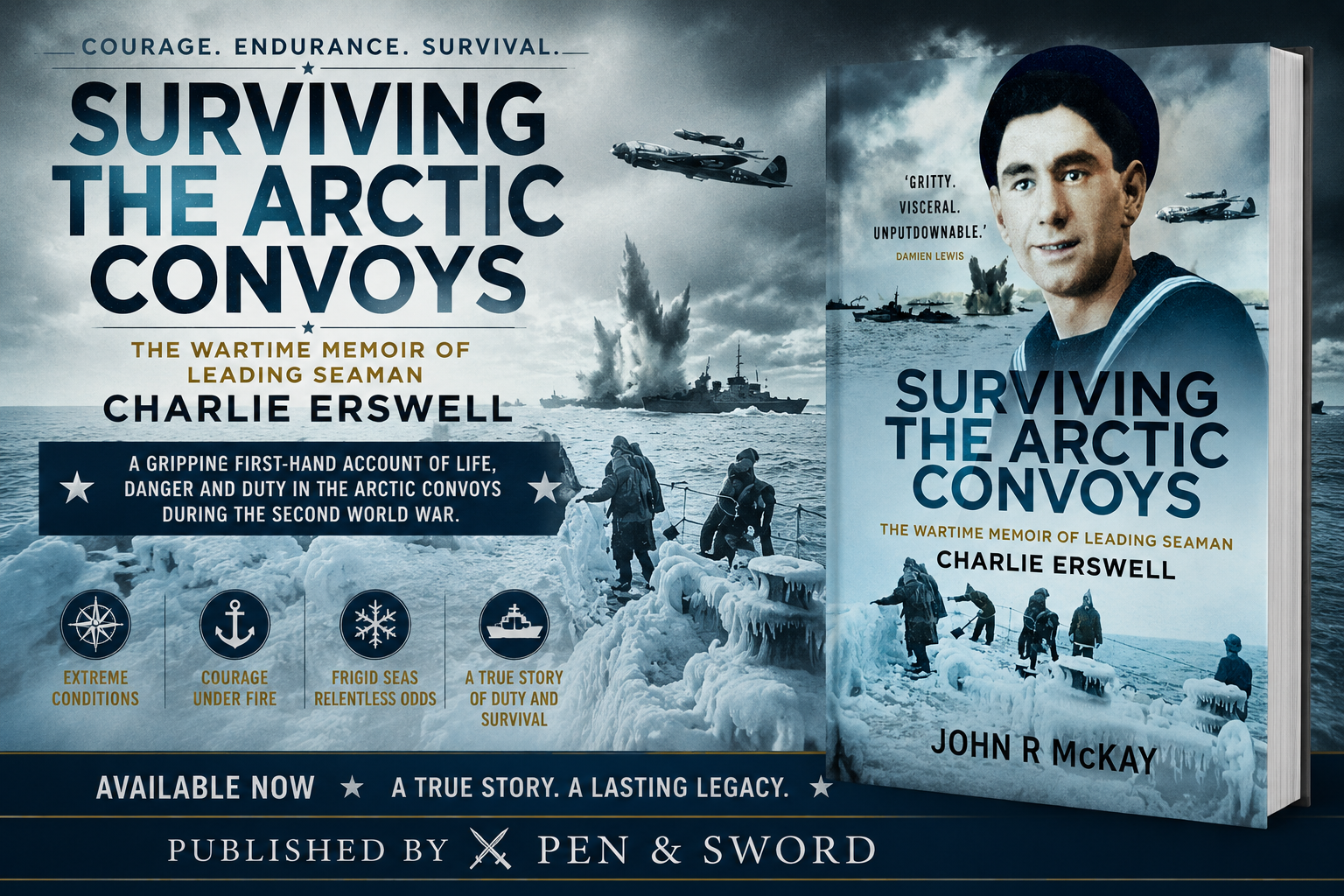
Surviving the Arctic Convoys: The Wartime Memoir of Leading Seaman Charlie Erswell
Prologue
13 September 1942 – Barents Sea, south-west of Spitzbergen
We had been closed up at ‘action stations’ since crossing the Arctic Circle, and the temperature was now at an unbearable 25º below zero. Sleet and rain filled the air around us, as it had done for the past few days, but the fog that had seemed to follow us since leaving Iceland had now lifted. We were at a heightened state of alert and had been since we set sail from Hvalfjödur four days ago.
Suddenly, the tannoy broke the silence and a voice I recognized as one of the officers on the bridge informed us there were forty-four torpedo bombers approaching the convoy from the starboard side.
‘Can I see?’ asked the breech loader, leaning over my shoulder, grabbing my telescope and putting it to his eye.
‘They’re not planes,’ he declared after a moment. ‘They’re birds.’
From a distance they did indeed look like a flock of birds. There was no denying it. But out here, in the frozen wastes of the Arctic Ocean, they couldn’t be anything other than what the officer had told us over the tannoy. He just did not want to believe it.
This was clearly the Luftwaffe heading towards us, flying in line abreast no more than 200ft above the waves, the drone of their engines getting ever louder the closer they came; Junkers Ju-88s and Heinkel He-111s flying in tight formation. Almost fifty of them, each carrying two torpedoes and bearing down on us to attack the merchant vessels we were there to protect.
I pulled my mittens tight and flexed my fingers. Despite the cold, I felt confident. I was ready for them. After the brief skirmishes we had thus far endured, this was definitely something much bigger. But I felt fully prepared, determined and ready to do a good job.
From my position inside the turret I was able to take a brief look around me. Outside, as far as my eyes could see, grey skies looked down upon a choppy ocean. To the port side, many merchant ships laboriously sailed on through the ice floes, burdened with the weight of their vital cargoes. They relied totally on sailors just like me to protect them from the coming assault. I was aware that the men on those ships looked to us in the Royal Navy to keep them safe, their own pitiful defences being totally inadequate to deal with a concerted aerial assault.
To the north, beyond the convoy, through the sleet and rain I could just make out the silhouettes of huge icebergs. Like leviathans they observed us indifferently, the battle that was about to take place before them of no real concern.
As the gun trainer, it was my job to turn the turret in the direction of the enemy planes, whilst the gun layer raised and lowered the long barrels of the 4.7 inch guns. We followed the instructions of the Petty Officer, who received his orders from the director above the bridge. We were to line up the pointers as indicated, and then the breech loaders would pump shells into the guns and fire them at the approaching aircraft.
Although this was something we had been trained to do and had so far done well, the sheer number of the approaching planes made my heart beat faster, and I swear I could feel the blood pumping around my veins, warming me slightly despite the horrendous cold we were all having to contend with.
I grabbed the winding handles, my concentration now totally focused on the task ahead.
We had to prevent the Ju-88s and He-111s from dropping their loads. Each of those planes carried enough firepower to sink two ships. They simply had to be stopped. And we were the ones tasked to stop them.
A metal bucket was on the floor near to me, for anyone who might suffer from seasickness since, being at ‘action stations’, we were unable to leave our positions to go outside and throw up. I was fortunate enough not to suffer from that particular malady, but the stench the bucket gave off, whenever my shipmates were forced to make use of it, only added to the general discomfort of operating in such a confined space.
I took a breath and readied myself. No sooner had I settled than the order was given to open fire.
We worked methodically, turning the turret and fixing on the targets as they approached. The breech loaders worked furiously, pumping shell after shell into the guns and firing them skyward, where they exploded amongst the approaching aircraft. The noise was horrendous as each shot was fired, the breech shooting back to eject the empty shell cases on to the floor around us. The smell of cordite filled the turret, the smoke mixing with the condensation from our breath as we worked furiously to repel the attack.
Above this din the Petty Officer shouted his orders, and we had to strain our ears to hear him. Our concentration could not lapse for a single moment.
As I wound the handles back and forth, lining up the pointer on the targets, we could clearly hear the sound of the engines in the German planes as they swooped down to drop their deadly ordnance. All around us was the sound of explosions, mixed with the unmistakable noise of the ‘pom-poms’, Oerlikons and machine guns, as the weapons from all the ships of the screen joined the aerial barrage.
I continued to follow the pointers as the range was adjusted, listening intently to the Petty Officer’s orders. More explosions filled my ears, closer this time, and I had a feeling of dread that things were not going well out there. Had some of the planes got through? Had some of the ships been hit?
I could not think about that right now. I had to keep going, despite the cold that was trying to numb my body, the elements trying to stop me from carrying out my duty.
I shivered. It was all so very cold. I never knew temperatures could go this low. It was incessant. I feared that if the Germans did not do for me, then the cold of the Arctic would.
However, we had to put that fear to one side and carry on.
For our comrades depended on us.
Recent Comments